This week’s guest poster is author Trish Moran who discussing the concept of cloning. Enjoy.
Present Day Cloning
Since Dolly the sheep, was cloned in 1996, cloning has been in the news quite frequently. There are stories of monkeys, cows and racehorses which have also been successfully cloned.
In 2005, laws were passed to control human cloning but they were ambiguously worded and received ambivalent support from different countries around the world.
An article in a Sunday newspaper said that a Chinese research group had claimed that they had reached the point where they were able to clone a human being but that they had not done so due to ethical considerations.
Many people argue that in certain situations cloning is acceptable and a way forward to prevent or treat genetically inherited conditions.
But for many, it still seems the thin edge of the wedge. Are we heading for designer babies? Or, behind the scenes, are scientists already well on the way to achieving this?
The big fear is, how far have scientists developed methods to clone humans and has it already been done somewhere?
Looking to the future
If we take a look into the future where modern technology plays an increasingly important role in medical development, it seems inevitable that human cloning will play a major role. And that in the wrong hands it can be misused perhaps for mercenary purposes.
If we are looking at cloned body parts to replace or repair the original donors’ organs, could we end up with copies of the originals as a bank of spare parts? If a person has the money to do this and was given the opportunity to do so, why not.
We are all behind medical advances solving the problems of inherited conditions and replacement prosthetic limbs and organ support to give every individual the opportunity to live life to the full.
Stephen Hawking, who had so much to give to the scientific community and in fact to the world in general, is a shining example of modern technology put to use to provide the best possibility for someone to live a full life against overwhelmingly odds.
Ethical Issues
If we can clone a human, why stop there? Why not make that person a superior version of the original? Why accept the inferior version of human life? We could jump even further ahead and consider Artificial Intelligence. In the future, will AI guidance dictate what is an ‘acceptable human’?
Another factor to consider when envisaging a future with cloned humans as part of our society, will the clones be independent people with equal rights to their original donors and other humans? Would they be considered a new strand of the human race?
How might cloned humans view religion? Would they consider God to be their creator? Or would they see human or even, eventually, AI scientists as the great creators? There is the fear that some people might even take advantage of this for their own purposes.
There are more questions than answers as we look towards the future and modern technology in medical advancement. And some of these answers can be very perturbing.
 About Trish Moran
Author of the Clones trilogy, a fantasy adventure about a group of teenage clones set in the near future. Trish Moran is a writer, a reader and a teacher.
After a decade of living in Athens, Greece and a three-year stint in Melbourne, Australia; she is now living in her hometown Burton-on-Trent once again.
She is intrigued by the fast-moving pace of modern technology and the influence it has on our lives. Add a twist of imagination to an idea of what these developments could mean for us in the future, add a little fantasy and adventure…
There are stories all around us waiting to be written!
Book: Mirror Image
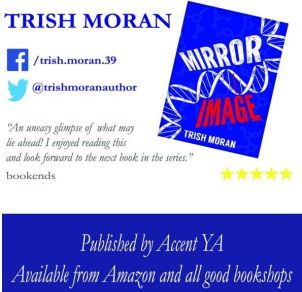
Clones – Humans or Products?
Journey into the future where technological developments mean that death or disability can sometimes be cheated, at a price. Cloning holds the key.
Would Clones be granted human status? Would they have equal rights to other humans? Or would they merely be classified as products of advanced technology?
Fifteen-year-old orphan, Stella, on the run from State care, finds herself caught up in their desperate fight for equality when she joins a group of clones of around her own age who have escaped from a sinister medical centre where financial gain is held much higher than human values.
Can the young teenagers take on the rich and powerful and win their fight for recognition?
Book one, Mirror Image, available now, Book two, Altered Image, available later this year.
~ ☆ ~ ☆ ~ ☆ ~
Big thanks to Trish for guest posting, do make sure to check out her social media pages. If you have any thoughts on this topic of cloning or have any questions or queries for Trish, please drop them in the comments below!
 Author Ari Meghlen Official Website
Hi Clare,
I love reading, too. I always have a book at hand! I’d be lost without my kindle, though I enjoy reading a real book, too! I can spend many a happy hour in the local library!
Hi Anne,
I do read a lot of YA fiction. I like reading (and writing) for YA because you can get away with a bit of a stretch from reality that adult readers might not accept! I also enjoy reading adult books – cosy mysteries, some romance, thrillers if they’re not too violent! I enjoy quite a wide variety of books. I always have to have a book at hand!
The book sounds fascinating- it sounds like she’s asking all of the right questions to get readers thinking 🙂 Thanks Trish and Ari!
Thanks for the comment Anne, glad you liked it 🙂
Thank you for your comment. Do you read YA fiction yourself? I see you are a writer of non-fiction history.
I was interested in your beta reader article on your blog page. As a teacher, I know how important it is to present criticism in the most positive way, and for the recipient to accept guidance to improve work. Useful tips! Thank you.
Thanks, Trish! I’m’ working with historical fiction (though I’m pretty hooked on reading the non-fiction, fascinating stuff!) but I LOVE a good YA read. When I was over-busy with full time teaching, I’d justify taking a break and reading MG and YA as ‘research time’ 😀 Whatever the age group or genre, I just enjoy a good story! What about you?
I enjoy YA books and also a variety of adult books. I’ve just finished two adult books – Checking Out by Nick Spalding, a really funny novel despite a dark theme and The Transition by Luke Kennard, set in the future. I’ll be looking for a YA novel next! The local library has a good selection. I wish my kindle had a YA section in the bookstore.
Very interesting article. Thanks Trish – and Ari for sharing!
Thank you for your comment. I see you have a wide variety of interests! Are you a writer as well as a reader?
Thank you, Trish. No, I’m no writer – I just love reading!
Thank you, Trish! These are fascinating, challenging and scary topics and you presented them well. 😊
Thank you for your comment.
I find listening to the news of new technological developments fascinating, but also worrying!
Looking forward to checking out your website! I’ll be taking a look at your books on my kindle.